
Citydle: Find the Mystery City in Six Guesses
Six guesses to find the mystery city, with distance, a compass arrow and colour clues after each one.
How to play Citydle
Name any city to start
Start typing a city on the keyboard. Citydle suggests matches as you type, which helps with long or unfamiliar names. Pick one from the list, or finish typing, then press Enter.
Read distance, direction and colours
Each guess shows the distance in kilometres and an arrow pointing toward the hidden city. Orange means the right continent, wrong country. Yellow means the right country and continent. Gray means neither matches.
Close in before the sixth guess
Use the shrinking distance to hop toward the target. When the distance hits zero and the row turns green, you found the city. If you miss six times, the answer is revealed.
Related Games
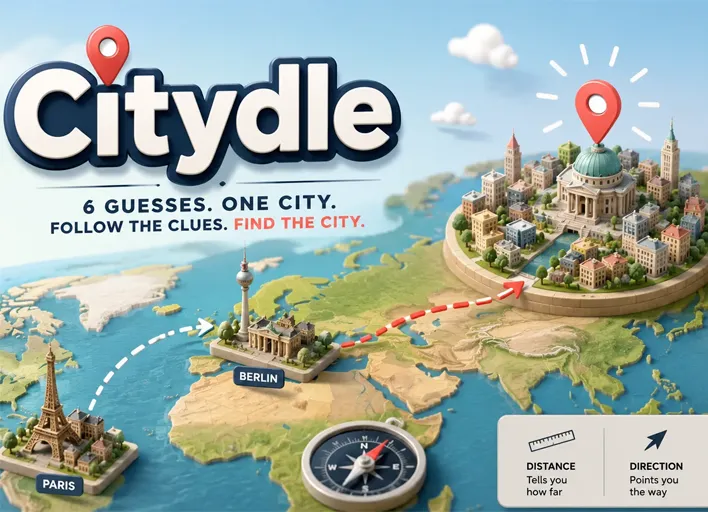
What is Citydle?
Citydle hides one real city every day, usually a capital or a place big enough to appear on a classroom wall map. You get six guesses to find it. Even a wrong guess helps, because the game answers with numbers, an arrow and colours instead of silence.
That feedback loop is what separates Citydle from a trivia quiz. A guess that felt close can still be thousands of kilometres off, which is half the humiliation and half the fun.
Distance, arrows and colours explained
Distance tells you how far your guess was from the answer, and a smaller number means you are warmer. The compass arrow shows which way to travel, which forces you to picture the globe instead of a flat map.
The colours add a second layer. Orange confirms the continent. Yellow confirms both country and continent. Gray says both checks failed, so your next guess should probably jump to another part of the world.
How to use six guesses wisely
Citydle gives you only six rows to locate a whole city, so the first guess is often cartography rather than bravado. A capital on another continent is a fine opener if it fixes the direction.
Say you open with Paris and get thousands of kilometres plus orange. Europe is confirmed. A follow-up like Berlin might cut the distance sharply and show yellow, which tells you the answer sits in the same country.
Citydle tips
- Open with a well-known city far from where you think the answer is. The direction arrow does the rest.
- Trust the arrow over your gut. Great-circle paths can look odd on a flat map.
- Lock in the continent first, then the country, then the city.
- Use the suggestion list for spelling. You don't need to type a full name.
- If you like the daily puzzle routine, try the one-letter ladder at Poople Unlimited too.
Citydle FAQ
How many guesses does Citydle allow?
You get six attempts per daily puzzle. Each guess must be a recognisable city. The round ends in victory when you name the exact city, or in defeat after the sixth miss, when the answer is revealed.
What does the distance number mean in Citydle?
It is the straight-line gap between your guessed city and the hidden answer, in kilometres. A smaller number means you are warmer.
How do the orange and yellow colours work in Citydle?
Orange means your guess is on the correct continent but in a different country. Yellow means you are in the right country and continent. Gray means both region checks failed.
Do I need to spell the whole city name in Citydle?
No. Partial typing opens a list of likely cities, which helps when the name is long or has accents you would not spell from memory.
What kinds of cities appear in Citydle?
Answers lean toward well-known cities and national capitals rather than tiny villages. You can still guess almost any city, but the hidden target is chosen so a curious traveller has a fair shot.
Is the Citydle puzzle the same for everyone each day?
Yes. The daily city resets on a shared schedule, so friends can compare how many guesses they needed without spoiling different answers.